
Choose your payroll market
Start with your employing entity. Local statutory treatment and reporting remain country-specific, even when a regional team reviews both payrolls.
What a monthly service can cover
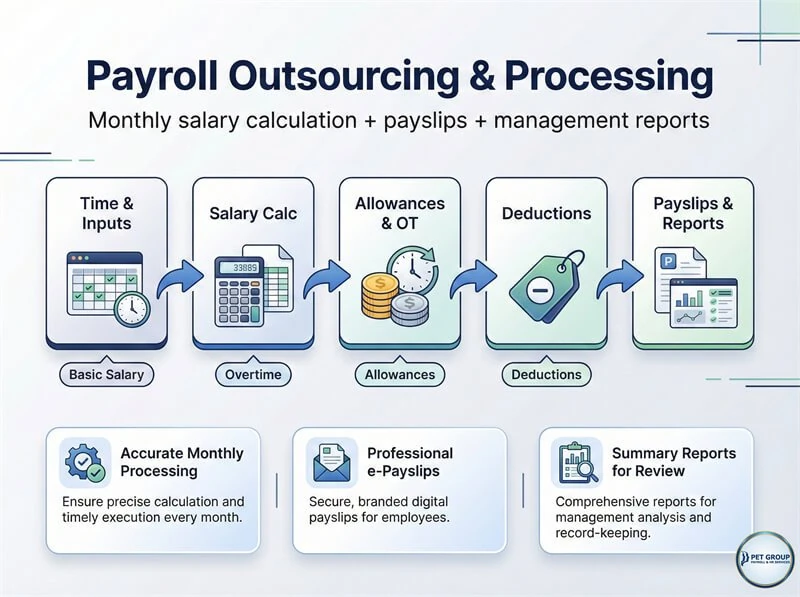
| Stage | Inputs and agreed outputs |
|---|---|
| Employee changes | New joiners, resignations, salary revisions and approved bank-detail changes. |
| Variable pay | Approved overtime, allowances, claims and leave adjustments, mapped to defined pay codes. |
| Processing | Gross-to-net calculation, draft payroll register and questions for your nominated reviewer. |
| Review | Headcount movements, unusual changes and reconciliation of approved payroll totals. |
| Release | Bank files, employee payslips and statutory outputs within the contracted scope. |
| Reporting | Payroll cost summaries and agreed accounting or cost-centre outputs. |
Define responsibility before the first run
Your employer team approves employee changes and payroll results and retains authority over payment release. Agree who prepares, checks, submits and pays each output. Submission-file preparation and payment execution are separate tasks; neither should be assumed from a general service description.
A useful scope also identifies the number of entities, pay frequencies, off-cycle arrangements, reporting formats and response route for employee questions.
Explore the supporting services
Questions employers ask
Do we need to replace our HR system?
Not necessarily. First review the available exports, identifiers and required outputs. Any integration or conversion work needs an agreed scope and testing.
What affects the monthly fee?
Headcount, number of entities, processing frequency, variable pay, reporting and optional work all matter. See our payroll cost guide before requesting a proposal.